You’re going to need a bigger blog

This summer, there were numerous sightings of sharks at Cape Cod, not too far from where I have vacationed for the last three years. Since the water in Massachusetts is far too cold for my Caribbean blood, I thought I would get in the spirit of the season by reading a book to keep me out of the water: Jaws by Peter Benchley.

I’ll start by saying: I liked it, but in this instance, the movie was better. Maybe it’s because I grew up on an island. Maybe it’s because I’ve seen the movie so may times. Whatever the reason, the book didn’t scare me like the movie did. The movie really kept me out of the water for a while – everything seemed like a real danger! The book just didn’t do it for me. But for the $1.50 I spent on it, it was worth it.

There’s quite a bit that was trimmed out of the movie, which I thought was a smart choice. The book dealt with infidelity and mobster business… ALL of which I thought took away from the central purpose of the book: A giant man-eating shark. Yes, it’s interesting to read a bit more about the characters… have them a bit more fleshed out… but so much of the book was boring and drawn out. I found myself speeding through pages simply to get to the more exciting shark scenes.  Yes, it’s interesting that the mayor of the town was threatened by the mob to keep the beaches open for money, but at the end of the day… I don’t care.

Spielberg did a fine job of adapting the book to the screen. Many of the scenes were spot on with the book. Towards the end when the three men go out into the water to search for the fish, the movie created at atmosphere of camaraderie between the characters during a long overnight expedition. In the book, the men went chumming through the water and returned to shore at the end of each day. I didn’t have much sympathy for the characters in the book… in fact; I was rooting for the shark in some places.

From what I’ve gathered from reading about other Benchley books… This was the most successful. The rest of the books were flops. I think the book happened to come out at the right time and Spielberg struck while the iron was hot and turned an interesting concept into a fantastic blockbuster film. So, farewell and adieu to the writings of Peter Benchley. I’ll drink to your leg, Steven Spielberg.

The Cash Cow

Young adult fiction seems to have taken center stage in Hollywood in the last few years. We’ve already seen comic book adaptations like Superman, Batman and most other ‘-man’ type heroes, and with their success it comes as no surprise to see the movie industry cashing in on the most dedicated cult-following fans.  I think it’s marvelous that people are reading as much as they are now (thank you, Harry Potter?), but I do have to raise an eyebrow at some of the crazes. Namely, Twilight and Fifty Shades of Grey. Hmm, how funny: FSoG was actually a Twilight fan fiction.

On a more positive note, I just discovered that two of the YA books I read this past year have been given movie deals: City of Bones and Matched. I wrote a previous entry about Matched by Ally Condie, and may have mentioned City of Bones… either way — these are both books featuring strong female characters in some type of futuristic, fantastic society. I enjoyed Matched quite a bit, and I’m currently working my way through the second entry of the series, Crossed. City of Bones took me a bit longer, but I have several subsequent books in the series and it’s all just a matter of time before I make my way through them.

In the meantime, I wanted to post links to some announcements I discovered from the Page to Premiere Network, which follows books through the movie-making process (hence the name).

Matched has a director

Image of the cast for City of Bones

It seems as though the only way to make blockbuster movies anymore is to get teenagers hormones raging for some steamy heart-throb. Don’t get me wrong, I know many of us enjoy and often appreciate the adaptations of our favorite books into movies, but I feel like there has been a huge generation of literature that has just been skipped over. Now, a book just has to be a number one seller on Amazon and, like a badge of honor, it gets a movie contract. Am I the only one NOT excited about a Fifty Shades of Grey adaptation? I haven’t read the series, so I have little room to judge, but from what I’ve heard, this will not bode well…

And while we’re on the subject of books-to-movies: In my next entry, I will review Peter Benchley’s Jaws and compare it to Steven Spielberg’s adaptation.

Into the Fold

Sometime after graduation I realized I became the beneficiary of a small, but substantial collection of LGBT literature from a student organization that I ran. For years the stack had been kept in a box, which had been handed down to me from the previous organization president, and I always felt somewhat guilty for having them. I tried handing them off to other LGBT organizations at school but no one seemed interested enough.

I’ve skimmed through several of the pages, and I even used some of the titles for a project in my reference class, but I haven’t actually read any of them. Thus, after three and a half years, I’ve decided to embrace them, and fully welcome these wayward titles into the fold.

  1. Bertram Cope’s Year – Henry Blake Fuller
  2. What the L? – Kate Clinton
  3. Love, Ellen – Betty DeGeneres
  4. Stonewall – Martin Duberman
  5. Coming Out: An Act of Love – Rob Eichberg, Ph.D.
  6. She’s Not There: A Life in Two Genders – Jennifer Finney Boylan
  7. Now That You’re Out of the Closet, What About the Rest of the House? – Linda Handel
  8. Out & About Campus – Kim Howard & Annie Stevens
  9. Bi Any Other Name – Loraine Hutchins & Lani Kaahumanu
  10. Y: The Descent of Men  – Steve Jones
  11. Zami, Sister Outsider, Undersong – Audre Lorde
  12. Queer Stories for Boys – Douglas McKeown
  13. The Elusive Embrace – Daniel Mendelsohn
  14. Gay Science: The Ethics of Sexual Orientation Research – Timothy F. Murphy
  15. And The Band Played On – Randy Shilts
  16. Boyfriend 101 – Jim Sullivan
  17. The Little Book of Neuroses – Michael Thomas Ford
  18. Love Shook My Heart – Irene Zahava

Would Johann Cry?


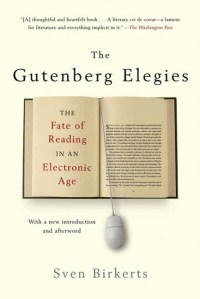
The Gutenberg Elegies is a necessary piece of writing in a much larger body of work regarding literature and the progression of digital reading technologies. Having been republished twelve years after its initial publication, with the inclusion of a new introduction and afterward, helps put the writing between two contextual bookends that, in some ways, simultaneously justify and excuse Birkerts’ original intent. This is one of Birkerts’ most well-known books, though he has written several others all revolving around the issue of writing and literature, including Reading Life: Books for the Ages and Then, Again: The Art of Literary Memoir.

Birkerts’ reason for compiling these fourteen essays is his call-to-arms in an attempt to fortify the edifice of literary intelligence against the swiftly approaching army of screens and microchips. He divides this battle into three parts: the first containing six autobiographical chapters, the second made up of four technology focused musings (including audio books and interactive CD-ROMs), and lastly, an appropriately named ‘Critical Mass’ section, in which he investigates and expands upon the writings of other scholars in the field. From the first several chapters, Birkerts writes about his own life and musings about the subject of literature and the act of reading. In his writing, Birkerts does not cite very many other works, indicating that many of these thoughts are his own. He frequently references Marshall McLuhan, but all together he cites about a dozen books and articles combined.

Initially, Birkerts seems quite resistant to technology, often making claims that our intellectual capacity will diminish without the constant exercise of literary discourse. He mentions one particular class of students he tasked with reading “Brooksmith” by Henry James. When asked how they liked the book, many students bemoaned the labor intensive read, citing they “just didn’t get it.”  At this, Birkerts began to examine the reasons why students of this generation would have such a difficult time and noticed that this was marking a significant shift in the way we read.

“I am not about to suggest that all of this comes of not reading Henry James. But I will say that of all this comes not being able to read James or any other emissary from that recent but rapidly vanishing world. Our historically sudden transition into an electronic has thrust us into a place of unknowing.” (21)

Throughout many of his essays, Birkerts grapples with what he frequently calls the paradigm shift. He takes note of the important advancements the digital age is bringing to the world of reading and writing, but much like hugging an over-zealous member of your extended family, Birkerts struggles with fully embracing the notion. In some ways, it seems he is trying to appease readers on both sides of the argument, pro and con. He approaches technology with apprehension, often times turning his back all together, firmly planting his feet and crossing his arms while keeping a wary eye on how his surrounding world is hurtling towards the new digital age.

Several of the essays are quite nostalgic; Birkerts recounts the impact that reading, writing, and books had on his life and intellectual development. In many of his essays, Birkerts justifies Marshal McLuhan’s popular phrasing “the medium is the message,” yet in other essays he seems to forget that the notion was ever mentioned.

“If anything has changed about my reading over the years, it is that I value the state a book puts me in more than I value the specific contents. Indeed, I often find that a novel, even a well-written and compelling novel, can become a blur to me soon after I’ve finished it. I recollect perfectly the feeling of reading it, the mood I occupied, but I am less sure about the narrative details. It is almost as if the book were, as Wittenstein said of his propositions, a ladder to be climbed and then discarded after it has served its purpose. No matter what the shape or construction of the latter, the ideal state of arrival is always the same. Deeply familiar – like the background setting of certain dreams…”(84)

He claims that it is the book itself that makes him feel this way, however he cites nothing about the physical object; never does Birkerts mention the smell of the pulp, the texture of the page or the weight of the book or binding, therefore his argument, by default, rests on the act of reading itself. Yet the act of reading in the digital age has not changed. In his afterward, Birkerts says, “The real message, as Marshall McLuhan proposed a good half century ago, is the medium. The playing, not the play, is the thing. I hewed to the same basic premise in writing the original essays in this book, and it holds for me now, but in a new, more specific way” (244). In this way, we see that Birkerts is struggling with the subject. On one hand, we notice his reluctance, but on the other, we see the benefits of the advancements in the digital age. This interplay creates what I find to be a very interesting tension, in many ways mimicking the feelings of many readers today. Therefore, I do not find him a hypocritical author, but rather, a realistic and dynamic one instead.

From the introduction to the 1994 edition of the book, Birkerts tells us that each of the fourteen essays in this book were written independently of one another (and therefore asking a pardon for any time he repeats himself, saying that the subject “cannot be sufficiently remarked”) yet all share a common theme. Every so often, referencing to the introduction helps remind us of Birkerts’ true intentions. Since these essays were written separately, Birkerts admits that they were not necessarily to be read in a linear fashion, but rather in groups sharing a common space (hence the different and distinct parts of the book). He also admits that some of the essays were a bit pessimistic, but ultimately, these were composed on his own mind “—that of the dreamy fellow with an open book in his lap” (7).

Birkerts has written this book for fellow writers, readers, and those concerned on the impact of digital media.  Soon after the 2006 edition of this book, Jeff Gomez published his take on the subject titled Print is Dead: Books in our Digital Age mere days before the release of Amazon’s eReader, the Kindle in November 2007.  Like Birkerts, Gomez highlights how important readership is in this transient period. Some aspects that Gomez highlights fill in the holes that Birkerts had not mentioned, including how similar the world of publishing and digital reading is to the music industry. He points out how Amazon has legitimized the digital copies of books with their eReader, the Kindle, just like Apple legitimized the downloading of digital music with their mp3 player, the iPod.

In 1996, two years after the first publication of The Gutenberg Elegies, Geoffrey Nunberg composed The Future of the Book, a similar compilation of essays, regarding the shift in technology. Various authors covering multiple facets of the subject, including historical, philosophical and linguistic perspectives, wrote the essays.  These writings consider that the computer will take neither complete nor immediate control over the publishing industry. Instead the different viewpoints maintain a steady balance of opinion.

The Gutenberg Elegies provides an interesting perspective on the transition from a printed literary culture to digital one. Though there are some topics that are absent from the text (such as the book as object, any in-depth historical facts, or current statistics), it supplies some insight into the perspectives of many minds in the literary community. Though written in the early – mid 90s, Birkerts still sounds remarkably current.  It seems he makes a point not to draw attention to specific technologies (aside from infrequent references to Nintendo and Sega) and in doing so, sounds very natural and relevant to the advancements since the second publication twelve years later. Reading either of the other two books mentioned in this review (Print is Dead, or, The Future of the Book) may offer a wider breath of knowledge in the subject, while the intention of Birkerts’ volume offers depth.
Blowing off the settled dust

Seems like I’ve fallen off the wagon for a while here, folks. The sickness has grown, and a full diagnostic exam is in order. I’ve read, and I’ve bought. And I’ve bought. I’m almost certainly in deeper than I was last year! With changes to my work schedule, summer class, personal issues, and then summer vacation, there has been several distracting ups and downs to say the least. (Not to mention, video games have wreaked havoc on my attention too!)  Time to get back on track!

I’m almost done reading Jaws by Peter Benchley — yes, the book came before the movie. I’m also still reading Crossed by Ally Condie, mostly because other books have grabbed my attention, and I’ve been trying to keep up with my book club. (Sorry ladies!) Next, I’ll probably take on Wind Through the Keyhole by Stephen King, and then I’ll focus on something quick and easy… that is to be determined. I’ll stagger a few of my posts on other books I’ve read so far, at least to fill in some space! I’ve got entries on a Michael Cunningham book and one on Sven Birkerts (that I technically wrote for a class, but hey! It’s still a review!)

Stay tuned 🙂

Signs of Progress

After months of reading inactivity due to vacations, final exams and family gatherings, I finally buckled down to read. I started reading Crossed, by Ally Condi – Book two in the Matched Trilogy, and I’m about 3/4s of the way through it, but as life events and work struck hard this spring, I had to put a pause to it. Instead I turned to my video games for more mindless entertainment, and after eating those empty calories, it was time to return to my diet.

I figured the best way to get myself back on track was to propose a deadline. Since I’m out school for now, a deadline is the last thing I needed. It seems as though my Book Club hasn’t had the best luck either. Perfect opportunity!

Hosting June’s meeting would not only allow me to select a book, but also adhere to a deadline — I can’t host a meeting if I haven’t read the book! Club members cried out for a Young Adult book… This month’s selection: Divergent, by Veronica Roth.

A la Hunger Games, Divergent is about a strong young girl, living in post-war(/apocalyptic?) Chicago sometime in the future. Oh, and of course it’s a trilogy. No love triangle though! (Not yet anyway. Just one boy for now.) The surviving society has split itself up into five different factions. Each faction blames the cause of the war on a particular human flaw, such as ignorance, cowardice and greed, and bolsters the virtues opposing them: intelligence, bravery, selflessness etc. Sounds very Seven Deadly Sins, and part of me wonders why Roth didn’t just come out and say that’s what she was doing, but it didn’t bother me too much.

At the age of 16, society members so through a (sorting hat) ceremony where they are presented with what faction they would be best suited for based upon their aptitude test (how well they do in a virtual reality video game 😛 ). Despite their results, they are free to select whichever faction they want.

Our protagonist, Beatrice (ugh) aka ‘Tris’ (better) is given inconclusive results from her test. Apparently, if you don’t fit into a prescribed role, aka, you are a well-rounded and balanced individual, you are considered “Divergent” (ooh ho ho ho, there you are, title namesake!)

The rest of the book, revolves around Tris’ initiation into the faction of her choosing and discovering that there are some secrets between the factions… SPOILER!!: Controlling the masses! WHAT?? You don’t say!

All in all, the book was a very quick read. At first I was really frustrated that the main character had ZERO personality, but after about 40 or 50 pages (which seems to be a trend with books lately… Entry on that later) she becomes someone who I actually cared reading about. I appreciate the gradual development of her character through the plot of this first book, and I’m interested to see how the rest of the series is handled.

Finally!

Wow guys!

I finally finished “If I Stay” by Gayle Foreman, the book club selection from MONTHS ago! I don’t know why it took me so long to trudge through this one… I think it may have been mostly due to changing jobs and not really getting much time to read during my breaks. Now that things are back in some type of order, (and my commute to work is only 5 minutes!) I can make my way through some more books!

I’m torn between reading “Crossed” (the second book in the Matched Trilogy) and “Divergent,” book one in yet ANOTHER trilogy. I really enjoyed “Matched,” but I’ve also heard wonderful things about “Divergent,” too…


While I make up my mind, I’ll update The List!

The Grey Troubadour?

Happy New Year! And what a year it’s shaping up to be…

This new year seems to have ‘change’ written all over it, and usually I’m not okay with that, but for some reason I’ve been blessed with the strength and patience to accept all that is happening. Besides, it’s better to live a dynamic life than a static one, right?

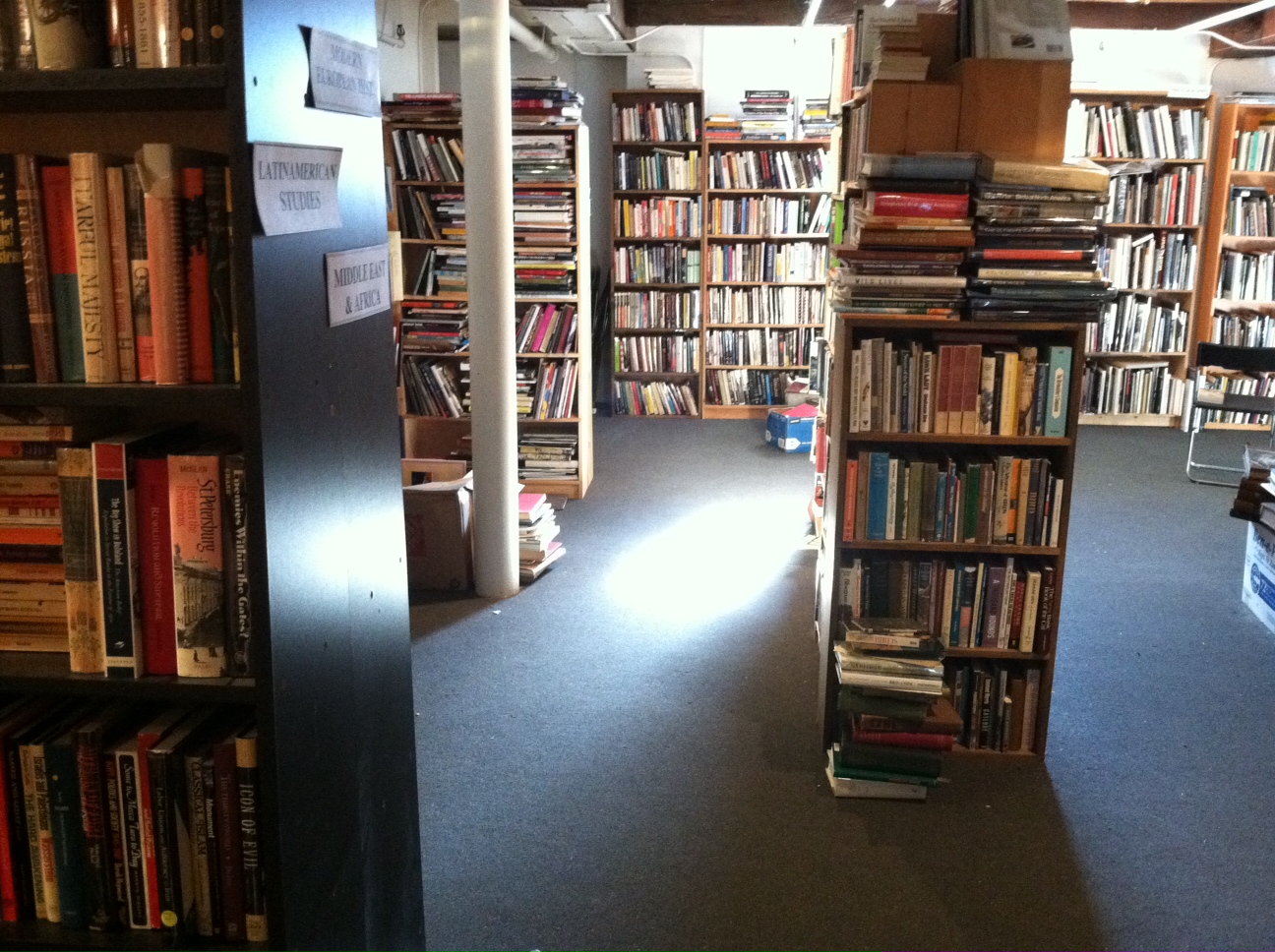
I happened upon a new book store just the other day, and I’ve fallen in love! It’s actually two used book stores that are in the same building, but the owner of one has gone blind, and has offered to merge collections with the other, making a gigantic labyrinth of mostly unmarked shelves and hours upon hours of exploration! (For those that live in the area and are interested: Grey Matter Books and Troubadour Books) Though pretty disorganized, the store has character. Some books were lined up in piles along the bottom of the shelves I suppose they’re supposed to be categorized under… but there are some severe space issues.

I probably spent an easy 45 minutes on two shelves of photography books alone — and I didn’t even look at them all! I have every intention of going there and camping out one day and looking at each one. Heck, I’ll probably end up reshelving the whole case…Maybe I can get something part-time on the side…? I wish!

And just in case anyone was wondering… NO, I did not buy anything! Though I was super tempted, I’m doing my best to stick by my rules! I have bent them slightly due to the amount of gift cards I got for Christmas and my birthday… but that’s a post for another time.

Stay tuned! An updated ‘sickness’ list shall appear by next post!

Format Face-Off

Yesterday I received an email from StephenKing.com’s Newsletter regarding his new addition to The Dark Tower series, The Wind Through the Keyhole, being released sometime in the spring of 2012. The seven-book-long series concluded several years ago (2004 I think), so this new volume is sparking some debate. “The series is already complete, why fuss with it?”

the wind through the keyhole stephen king


There is a clear split in the continuity of the books. After the fourth book was written, Stephen King was hit by a car and it was unclear whether he would survive, let alone if the series would ever be finished. Thankfully, both made it through the accident, but the final three books ‘feel’ different. King writes himself in to the series as a character, which could be seen as narcissism, but I think anyone reading The Dark Tower would understand that the world is expansive enough to include the author.

This new book is meant to take place in this gap between the fourth and fifth book, so book 4.5 really. However, my dilemma doesn’t fall with many other readers… Naturally, I will purchase this book, but the biggest question is the format. I’m already a bit disappointed that it’s just barely over 300 pages while the rest sit fat and happy on the shelf between 500 – 1000 pages.

All of The Dark Tower books I own are in paperback. It already drives me up the wall that the first four are mass market size and the remaining three are not. Now with this new addition, if I purchase it right away (come on, like I’m NOT going to preorder it!) it will be in hardcover. It may be another year or more before it’s available in paperback. I know this book is supposed to cover this marked shift in the narrative, but I don’t know if I want a glaring hardcover to mark the obvious shift on my shelf as well.

I know this isn’t really an issue. Some will say “but you have so many books, if you are disciplined, you’re not going to read through them all to justify buying this new book.” (Maybe by ‘some’ I mean my inner voice…) The release is still months away, so I suppose I have time… I just need to resist the Preorder Price Guarantee!

Discount Whore

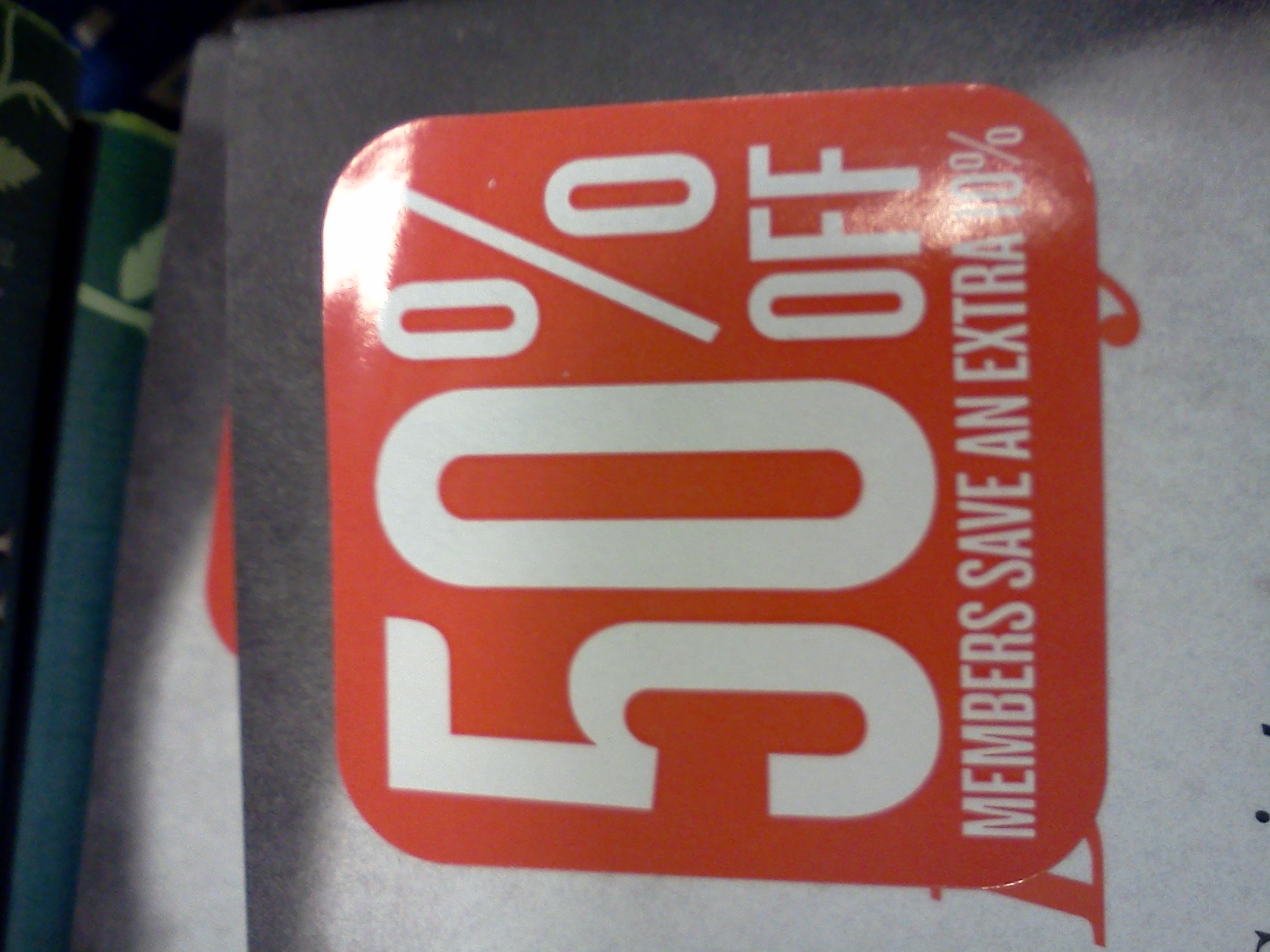
I’m not usually one to shake my head at a discount, especially when it comes to books, but I noticed this discount at a certain bookseller the other day and just had to share.

This is the sticker on a brand new hardcover book. That’s a grad total of 60% off when you’re a member! I feel like the booksellers are just whoring themselves out now! No wonder places like Amazon.com are making a killing and other places like Borders closed down…