Sophomore Slump

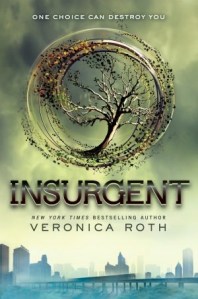
Picking up Divergent by Veronica Roth well over a year ago was another one of my impulse buys akin to my urge to pick up The Hunger Games. In fact, at the time, many people were touting certain books as “The Hunger Games Hangover Cure” and Divergent was one that satisfied my appetite beautifully. Insurgent, though it picks up immediately where Divergent leaves us, had me wondering when I would feel the same high I felt before.

 Insurgent

Okay, so I don’t dislike Insurgent. In fact, I found it pretty agreeable. There were a few choices that were made that made me question the direction the story is being taken… Such as *SPOILER* killing the major antagonist (yay for the good guys!… but seriously? There’s a whole ‘nother book!) and *ANOTHER SPOILER* a lot of people being divergent besides Tris (So… she’s not really special after all…?). What I did appreciate was a closer look at the inner workings of the other factions. Perhaps that’s really what this entry in the series was about: fleshing out the society a bit more, hinting at what could possibly be going on outside of the city. It seems as though there’s going to be a revolution within the revolution… which reminds me of the Matched trilogy. This entry still felt more like it was bridging a gap.

Throughout this book, I felt like the scenes were sort of cut and paste next to one another. One scene everyone is talking, talking, talking… Then there’s a lot of action and guns and running… Then back to talking and talking etc, etc. I wasn’t as interested in this book as I was when I first read Divergent – I found the world and premise fascinating, with simulations and faction hierarchy. In Insurgent, I felt like some of the rules were bent a bit: “Oh, you don’t remember what happened? It must have been a simulation.” *shrug*

That said, I am still looking forward to finishing up the series with Allegiant. I still enjoy the characters and their tensions/relationships. (BTW, definitely didn’t see the twist with Caleb coming!) It may be a while before I get around to Allegiant, but I have high hopes!

We Have REACHED The End

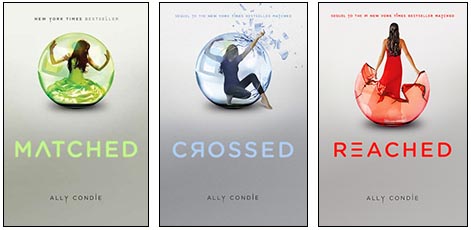
Nearly three years later, I can finally say I’ve completed Ally Condie’s Matched trilogy. I looked over my review of Crossed, book two from the series, and realized now how brutal I was in critiquing it (I’m sorry!) After finishing this final entry, I now feel more familiar with the author’s tone and have a better understanding and appreciation for the trio.

matched crossed reached ally condie

When I first read Matched, I was coming off of a Hunger Games binge, so my expectations were set for something much more action-packed or thrilling. Matched was more subdued. The premise hooked me right away: soon after their 16th birthday, teenagers of The Society are introduced to their life match in a grand ceremony. They are presented with a data card to take home and review their match’s profile, but once Cassia inserts her data card, she sees the face of a boy who is not the same as the one she was matched with during the ceremony. Was it a glitch in The Society’s perfect system? Cassia finds herself in the middle of secret love triangle and soon discovers that The Society’s cracked facade is starting to crumble. With the help of her two potential matches, Cassia investigates the mystery of The Pilot — a fabled leader meant to head up The Rising and overthrow The Society.

To sum up Crossed, Cassia is wandering around the Grand Canyon with one of her matches (Ky) and a few more teens and discover tubes containing preserved tissue samples from the members of The Society that have all died… presumably to bring the deceased back in the future. We still don’t know who The Pilot is, but it’s got to be one of the three from this love triangle, right?

Reached gives us the collapse of The Society and the takeover of The Rising by the use of a widespread viral plague. Certain members that have been selected by The Rising (since birth) are immune, and therefore unharmed… until someone pops up with a mutated version and then everyone’s at risk. That’s a big “Oops.” Cassia and her two matches are tasked with helping to discover the cure. Ky becomes infected by the mutation, but of course, he survives and is ultimately paired with Cassia.

There were some unexpected curve balls: The Pilot was just a random guy. The Rising was actually created by The Society as a way to feign a rebellion, to gain the community’s trust, and ultimately still be in control of everyone. There was no big blow-out fight for Cassia’s love. In fact, the two boys were stayed friends throughout the entire trilogy… so a bit anticlimactic.

Overall, though, the series has a very steady flow. The first book gave us one point of view, the second book introduced a new point of view, and the third book gave us three. When I first read Crossed, I found this flip-flopping to be a bit forced, but in reading Reached, I found it to be part of a natural progression in the story-telling. Condie’s descriptions of the setting of the story are vivid and beautiful. All of her characters are likable, but I’m not sure if it’s because everyone in The Society is groomed to be regulated and well-balanced, or if there was lack of more interpersonal conflict. I didn’t find myself disliking any of the characters… and I had a difficult time deciding which of the two matches Cassia should ultimately end up with because everyone was so “nice.”

I definitely would not call this the next Hunger Games. But for a strong young female protagonist living in a post-apocalyptic futuristic society in the middle of a love triangle, it fits the bill.

Oh, and a band of Archivists ran a black market of smuggled historical papers, objects, and other such paraphernalia. My future as a librarian is now justified. 

Budding New Books

Here’s the thing: In order to stay relevant, one must stay current. Which means more than writing a blog on a regular basis for my own self-indulgent reasons. It really means staying ahead of the game. So how does one maintain a steady stride with the rest?

ARC stands for Advanced Reader (or Review) Copy, which is a basically an early release of a book used as a promotional sales tool. These are typically distributed to booksellers, libraries and journalists (and bloggers) to review prior to the book’s release to help generate buzz and (ideally) positive feedback. These books are not for resale and therefore must be requested, typically from the publishers themselves. I’ve been given the opportunity to obtain some ARCs from a local bookseller and I’m taking a firm grasp of this fresh bounty.

Up until now, I’ve written here on a monthly basis, but I find myself swiftly moving my way through my list of books from my own personal library. It’s time to take the next step, so I propose to read and review ARCs to post here along with my own entries. The nature of the ARC will require that I keep to a deadline. It’s my hope to have at least bimonthly posts which will keep me writing on a frequent and more regular schedule. Once I get the hang of things, perhaps I’ll reach out to a publisher directly!

Stay tuned, readers! This shall be an interesting year!

Battle of the Books

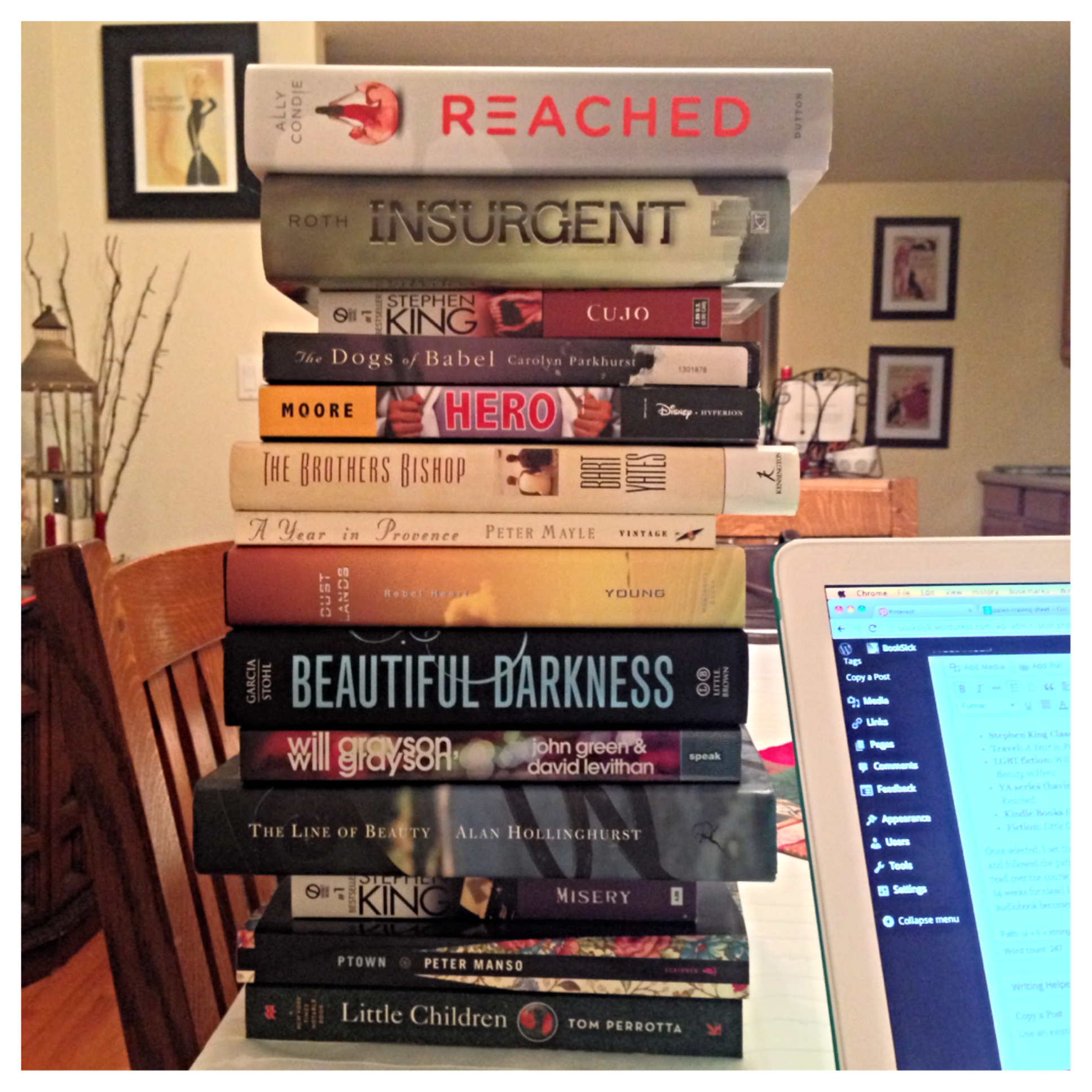
People may think my book choosing methods are strange, but honestly, I just find it amusing. Considering my lack of interest in sports, a book bracket may be as close as I get to some type of Fantasy League. Here’s the breakdown:

I chose two books from eight different categories, yielding sixteen titles total. (Well, six. I doubled up on two categories.)

  • Stephen King Classics: Cujo vs Misery
  • Travel: A Year in Provence vs PTown
  • LGBT fiction: Will Grayson, Will Grayson vs The Brothers Bishop / In The Line of Beauty vs Hero
  • YA series (having 3 or more titles): Insurgent vs Rebel Heart / Beautiful Darkness vs Reached
  • Kindle Books (fiction): Ten vs Better Nate Than Ever
  • Fiction: Little Children vs Dogs of Babel

Once selected, I set the titles against one another in their respective categories and flipped some coins and followed the paths of the bracket tree. The resulting list will govern the order of the books I will read over the course of the next year. With my recent acceleration in reading (like reading 35 books in 14 weeks for class) I imagine this will be a breeze. I may push a title to the front of the list as an audiobook becomes available through OverDrive or my library.

  1. Reached
  2. Insurgent
  3. Cujo
  4. Dogs of Babel
  5. Hero
  6. Ten
  7. The Brothers Bishop
  8. A Year in Provence
  9. Rebel Heart
  10. Beautiful Darkness
  11. Will Grayson, Will Grayson
  12. In The Line of Beauty
  13. Misery
  14. Better Nate Than Ever
  15. PTown
  16. Little Children
Battle of the Books
Battle of the Books

Here we go!

Waiting for Spring

For the class I’m taking this semester, I’m required to read some 35 books. Thanks to the library, Overdrive, and Audible, I’ve finished most of them in record time. In between my borrows and holds, I’ve snuck in a few titles from my own list, slowly marking them off too, but I feel as though I’ve hardly made a dent. In fact, after crossing off almost a dozen titles, I uncovered several books that I had yet to catalog, and all my feelings of accomplishment deflated. Then I realized just how many titles from my class I’ve completed. Of the 35, I’ve finished 26 completely with two more titles in progress. Though I can’t claim ownership over most of these titles, I also can’t help but feel as though they should be accounted for in some way. Once the class wraps and the semester is over, I plan on going through many of the titles… ones I liked and ones I didn’t particularly care for. After reading so many, I have lots to say! Thanks to this class, I have a much better sense of what really constitutes a young adult book… And it’s more than just strong-female-characters-in-a-post-apocalyptic-dystopian-world-trilogy.

As for my own personal collection… I continue to plod along. I feel discouraged at times when I look at the three bookshelves bulging with books. I’m very tempted to go through and weed titles out — shocking! — but I’m also having a difficult time choosing which I would part with… at least in any substantial quantities. I could probably come up with a dozen or so, but that number seems so inconsequential.  Each time to try to subtract a title, I justify keeping it, now for the sake of my librarian degree. “Oh, I may need that title for a reference in class one day!” Spring at the latest. That’s when the weeding will happen. If not before… It depends on how awful the winter is.


In other news… I received Veronica Roth’s Allegiant a day before the release date! This never happens to me — getting a pre-ordered item before it hits the streets. I always hear about it happening with books and video games, and I’m always jealous…Except I can’t quite enjoy it this time because I haven’t yet read Insurgent! Ugh!  At least I won’t have to interrupt the flow once I start reading them.  Now that I mention it, perhaps I should have another Gauntlet… Look forward to a throw-down in the next entry!

Rules of the Domain

As I approach another anniversary with this blog, I decided to go through and do a bit of housekeeping, both on the site and at home. After packing up my life and moving to a new apartment, many of my books have been scattered throughout my living space without any sense of order or proper placement. Though there may be a box or two of books still taped up, I was able to organize all that had been unpacked.

The end of summer marks the end of sunny vacations and hot, sticky days, but as autumn draws closer, my mourning is cut short. The fall ushers in a new school year. A time when the air is filled with potential. High expectations and a recharged sense of accomplishment. My summer has been far from uneventful — I believe I have read more books this summer than I have in the past several years. The selection was not the most traditional beach reads, but working my way through The Sickness has kept me steadily motivated.

Now that a new semester approaches, I am faced with a staggering mountain of books to read. (I should have known… it’s a young adult literature class!) Thirty-five books in total, to be read over a fourteen week period. “Oh, for sure I already own a good chunk of this reading list,” I thought. But after looking over the selection, I only recognized three titles: The Perks of Being a Wallflower, A Child Called “It”, and Flowers in the Attic. Less than 10% of this list were books I had heard of. I took pause. After a few calculations I looked down at my paper in disbelief.

Total Pages: 11,080

That staggering number has me freaked out. That’s an average of 121 pages every day — I’m lucky if I can read 12 pages a day! I took a moment to consider a few points: I’m starting the reading list early. I do not have to purchase any books. I have at least an hour of listening time for audio books every workday.

“Okay,” I said polishing my glasses, “Let’s do this!”

The last item of business to attend to was my domain. Not my living space, but my web domain. WordPress has been offering that I “Go Premium” ever since I started this blog, and underestimating my early commitment, I put off purchasing the dot-com for my site. Today I decided to make the purchase, solidifying my little blog in the Internet world, only to be sadly disappointed. “Go Premium today – make http://www.booksick.me yours” said WordPress. Wait, “dot-me”? What happened to dot-com? I quickly typed into the navigation bar, hoping my fear isn’t true… but unfortunately, it seems as though someone else has purchased the dot-com domain for booksick. It seems to be some type of search aggregator, but to be honest, I didn’t spend much time on the site, refusing to give the other pages more hits.

After a bit more research, the knife of remorse only dug deeper. The domain was purchased 31 August 2013 09:24:00. Just two days ago. The expiration is 31 August 2014 09:24:00 — and you can bet I have set my calendar. I’m staring down that date, now charged with even more purpose than before. It will be mine.

*  *  *  *

Currently, I’ve finished the two books chosen for Week 1, and I am working on a book from Week 2. I also found a book from Week 4 on OverDrive that I’ve been listening to while I wait for my holds at the library. Though my school books will not be listed within the master list, I will be sure to address them in each entry.

It’s Time I Knew Her Name

Hush, Faithful Reader,

Let’s diverge from this young adult trend, as ugly as that may seem. I’m hungry for the games of a more mature  friend. I’ve reached an opening in this maze and found my match, the legend: Stephen King.

How many YA books did I just reference? 😉

But I said her name. Stephen King’s beginning… Carrie. (Another that is seeing a new theatrical release, this upcoming October.)

Someone recently expressed their excitement about the new adaptation of Carrie and it got me thinking about King’s work. Then I realized that I owned the book and, like so many others, I haven’t read yet. Crazy, right?! It’s time to change that.

I’ve seen the 1976 movie as well as the sequel. *sigh* Stephen King’s books just do not translate very well into films. Unless Frank Darabont is directing, that is. Those seem to do well. That said: I am looking forward to this iteration of Carrie.

Gosh, I don’t mean to keep talking about films, but it seems as though that theme has proven to be rather influential/relevant lately. I promise not EVERY book I read and write about will have a movie tie-in. I swear!

Since the film doesn’t premiere until October, I’ve got more than enough time to work through the text. It’s not a particularly long book… around 300 pages… so I’m positive that it will be a quick read.

As a side note: I’m in the process of packing and moving! This also means reorganizing my collection. Exciting, and also busy! Especially with final class projects etc. Stay tuned!

Running on a Hamster Wheel

After picking a book up and being really excited about reading it– IT’S THE BOY VERSION OF HUNGER GAMES!!– I wasn’t completely impressed with The Maze Runner by James Dashner.

Maze Runner

I really struggled getting into this book. As I mentioned, I was looking forward to reading this book because there has been quite a bit of hype surrounding it. Along with so many other popular young adult series, this has also scored a movie deal. (Go figure.) Needless to say, I had high expectations. Some were met, some left my wheels spinning.  (Ha! – running…hamster wheel… spinning… see what I did there?)

We’ve got a teenage boy with amnesia that pops up in a world with bunch of other boys that have amnesia too. I think the author was trying to be clever in the reader’s connection with the protagonist — learning new information as they learned — but instead I found it downright frustrating. I felt as though a lot was deliberately being withheld such as “why do we do this?” or “what is that?” So many characters brushed off the protagonist, and therefore, the reader, which made me feel like the book was telling me “STOP READING ME! LEAVE ME ALONE!”

(Un)Fortunately, I was stuck with it through about 10 hours of plane rides over the last week and decided to plow my way through, breaking this wild horse of a book and beating it into submission. Rather than giving away any real plot points, mostly because I really want other readers to suffer like I did, I’ll just say that by the end of the book, I am intrigued.

Let’s see where the rest of this series goes. For now, I’ll catch my breath from my sprint through this book, stretch for a spell, and perhaps pick up another book with a more moderate pace.

Would Johann Cry?


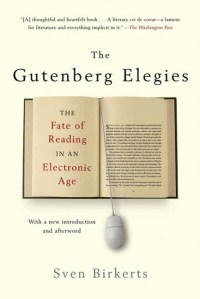
The Gutenberg Elegies is a necessary piece of writing in a much larger body of work regarding literature and the progression of digital reading technologies. Having been republished twelve years after its initial publication, with the inclusion of a new introduction and afterward, helps put the writing between two contextual bookends that, in some ways, simultaneously justify and excuse Birkerts’ original intent. This is one of Birkerts’ most well-known books, though he has written several others all revolving around the issue of writing and literature, including Reading Life: Books for the Ages and Then, Again: The Art of Literary Memoir.

Birkerts’ reason for compiling these fourteen essays is his call-to-arms in an attempt to fortify the edifice of literary intelligence against the swiftly approaching army of screens and microchips. He divides this battle into three parts: the first containing six autobiographical chapters, the second made up of four technology focused musings (including audio books and interactive CD-ROMs), and lastly, an appropriately named ‘Critical Mass’ section, in which he investigates and expands upon the writings of other scholars in the field. From the first several chapters, Birkerts writes about his own life and musings about the subject of literature and the act of reading. In his writing, Birkerts does not cite very many other works, indicating that many of these thoughts are his own. He frequently references Marshall McLuhan, but all together he cites about a dozen books and articles combined.

Initially, Birkerts seems quite resistant to technology, often making claims that our intellectual capacity will diminish without the constant exercise of literary discourse. He mentions one particular class of students he tasked with reading “Brooksmith” by Henry James. When asked how they liked the book, many students bemoaned the labor intensive read, citing they “just didn’t get it.”  At this, Birkerts began to examine the reasons why students of this generation would have such a difficult time and noticed that this was marking a significant shift in the way we read.

“I am not about to suggest that all of this comes of not reading Henry James. But I will say that of all this comes not being able to read James or any other emissary from that recent but rapidly vanishing world. Our historically sudden transition into an electronic has thrust us into a place of unknowing.” (21)

Throughout many of his essays, Birkerts grapples with what he frequently calls the paradigm shift. He takes note of the important advancements the digital age is bringing to the world of reading and writing, but much like hugging an over-zealous member of your extended family, Birkerts struggles with fully embracing the notion. In some ways, it seems he is trying to appease readers on both sides of the argument, pro and con. He approaches technology with apprehension, often times turning his back all together, firmly planting his feet and crossing his arms while keeping a wary eye on how his surrounding world is hurtling towards the new digital age.

Several of the essays are quite nostalgic; Birkerts recounts the impact that reading, writing, and books had on his life and intellectual development. In many of his essays, Birkerts justifies Marshal McLuhan’s popular phrasing “the medium is the message,” yet in other essays he seems to forget that the notion was ever mentioned.

“If anything has changed about my reading over the years, it is that I value the state a book puts me in more than I value the specific contents. Indeed, I often find that a novel, even a well-written and compelling novel, can become a blur to me soon after I’ve finished it. I recollect perfectly the feeling of reading it, the mood I occupied, but I am less sure about the narrative details. It is almost as if the book were, as Wittenstein said of his propositions, a ladder to be climbed and then discarded after it has served its purpose. No matter what the shape or construction of the latter, the ideal state of arrival is always the same. Deeply familiar – like the background setting of certain dreams…”(84)

He claims that it is the book itself that makes him feel this way, however he cites nothing about the physical object; never does Birkerts mention the smell of the pulp, the texture of the page or the weight of the book or binding, therefore his argument, by default, rests on the act of reading itself. Yet the act of reading in the digital age has not changed. In his afterward, Birkerts says, “The real message, as Marshall McLuhan proposed a good half century ago, is the medium. The playing, not the play, is the thing. I hewed to the same basic premise in writing the original essays in this book, and it holds for me now, but in a new, more specific way” (244). In this way, we see that Birkerts is struggling with the subject. On one hand, we notice his reluctance, but on the other, we see the benefits of the advancements in the digital age. This interplay creates what I find to be a very interesting tension, in many ways mimicking the feelings of many readers today. Therefore, I do not find him a hypocritical author, but rather, a realistic and dynamic one instead.

From the introduction to the 1994 edition of the book, Birkerts tells us that each of the fourteen essays in this book were written independently of one another (and therefore asking a pardon for any time he repeats himself, saying that the subject “cannot be sufficiently remarked”) yet all share a common theme. Every so often, referencing to the introduction helps remind us of Birkerts’ true intentions. Since these essays were written separately, Birkerts admits that they were not necessarily to be read in a linear fashion, but rather in groups sharing a common space (hence the different and distinct parts of the book). He also admits that some of the essays were a bit pessimistic, but ultimately, these were composed on his own mind “—that of the dreamy fellow with an open book in his lap” (7).

Birkerts has written this book for fellow writers, readers, and those concerned on the impact of digital media.  Soon after the 2006 edition of this book, Jeff Gomez published his take on the subject titled Print is Dead: Books in our Digital Age mere days before the release of Amazon’s eReader, the Kindle in November 2007.  Like Birkerts, Gomez highlights how important readership is in this transient period. Some aspects that Gomez highlights fill in the holes that Birkerts had not mentioned, including how similar the world of publishing and digital reading is to the music industry. He points out how Amazon has legitimized the digital copies of books with their eReader, the Kindle, just like Apple legitimized the downloading of digital music with their mp3 player, the iPod.

In 1996, two years after the first publication of The Gutenberg Elegies, Geoffrey Nunberg composed The Future of the Book, a similar compilation of essays, regarding the shift in technology. Various authors covering multiple facets of the subject, including historical, philosophical and linguistic perspectives, wrote the essays.  These writings consider that the computer will take neither complete nor immediate control over the publishing industry. Instead the different viewpoints maintain a steady balance of opinion.

The Gutenberg Elegies provides an interesting perspective on the transition from a printed literary culture to digital one. Though there are some topics that are absent from the text (such as the book as object, any in-depth historical facts, or current statistics), it supplies some insight into the perspectives of many minds in the literary community. Though written in the early – mid 90s, Birkerts still sounds remarkably current.  It seems he makes a point not to draw attention to specific technologies (aside from infrequent references to Nintendo and Sega) and in doing so, sounds very natural and relevant to the advancements since the second publication twelve years later. Reading either of the other two books mentioned in this review (Print is Dead, or, The Future of the Book) may offer a wider breath of knowledge in the subject, while the intention of Birkerts’ volume offers depth.