A Fever in my Blood


Boy, this took me long enough! I finally, finally, got around to reading Rebel Heart by Moira Young, book 2 in the Dustlands trilogy. I happened upon Blood Red Road (book 1) while I was in Canada one summer. Without having heard much about it before, I picked it up, because I couldn’t leave a bookstore empty-handed. Honestly, I didn’t begin reading it until a few months later, but once I did, I flew through the pages. Once I realized there were to be two more books following, I pre-ordered the titles as soon as they became available. That was a few years ago now, and since I loved BRR so much, I wanted to be sure Rebel Heart made it on my list of books to read this year.
Rebel Heart, Blood Red Road, Dustlands, Moira Young


The first thing you’ll notice about the Dustlands trilogy is the way it is written. That may sound sort of generic, but flip through the pages and you’ll see there are no quotation marks indicating speech. It is also written in the vernacular of the world. G’s are dropped from words ending with ‘-ing,’ instead of ‘for’ it’s ‘fer,’ rather than ‘afraid’ it’s ‘afeared,’ ‘can’t’ is ‘cain’t,’ etc. Honestly, it felt really odd for the first 40 pages or so, but soon you find yourself in the rhythm and you don’t even notice. Sometimes, the line spacing even makes the prose feel like verse… which may sound weird, but it works!

Moira Young does a marvelous job of supplying the reader with just enough detail. Sort of like a watercolor painting, her words suggest description while leaving us to fill in the specifics with our own imagination. It’s remarkable how liberating that feels… but I didn’t realize it until after I was through reading the book. It’s not like other writers that will ramble for pages about the bark of a tree.

Rebel Heart starts with a shift in perspective – we hear from another character’s point of view. Immediately I thought about Ally Condie’s Matched trilogy, wondering if this book would follow the same pattern: book 1, one perspective – book 2, two perspectives – book 3, three perspectives. In this case, the shift serves as a prologue. The book picks up pretty much where the first left off. (I’m purposefully leaving out characters and plot points for spoilers — Yeah, I’m being nice this time. You’re welcome.) Again, it took me a little while to get into the stylized rhythm, but I adjusted. The character names were all familiar, but I had to remind myself who was who from the previous book.

Saba, the protagonist, is the same as she was – stubborn, fierce, and unrelenting. After the events of the first book, it’s rewarding to see her struggle and develop through this next installment. She’s not perfect. Often I feel as though these strong-female-protagonists-in-a-post-apocalyptic-dystopian-world-for-young-adults all start to blend together. Not so with Saba. Her inner conflict is so… I wanna say textured, but that sounds weird… It’s pebbly and rocky, if that makes sense. And a few times, her decisions made me go “what?!” — and THAT’S what makes her such an interesting read. Saba is easily my favorite protagonist in this genre so far.

Oh, and speaking of genre. Something I should mention: this is very much a Western. That may shock you readers, but I urge you to give it a try. There are a lot of John Ford and John Wayne influences… In fact, does anyone remember The Searchers (1956 film)? If you liked that, you’ll definitely like this series. Now that I think about it, I suppose book 1 sort of follows along that same kind of story too.

Hopefully it won’t be another 3 years before I read the final book, Raging Star!
 

No Awful Books – EVER!

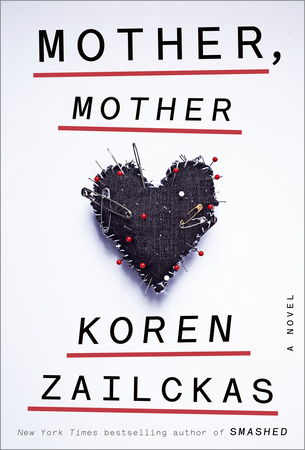
A few months ago, I found a new website through Twitter called Blogging for Books. Immediately, I registered. The premise is simple: Choose a book, read the book, review the book. As someone who is desperately trying not to purchase any more books, I’m thankful for this little loophole of a website. That said, in my new job, I’m finding it increasingly more difficult to actually READ rather than LISTEN to books. Hopefully this doesn’t disqualify me from my review, but I happened to find the audiobook version and got through the book that way, since I was having a difficult time paging through it. So here we go: my review of Mother, Mother.

 mother, mother koren zailckas

Touted as “Mommie Dearest” and “Psycho,” I had hopes this book would be thrilling and emotionally charged, perhaps cultish. Unfortunately, by the time I finished, I was still waiting for a crazy murder scene. I will say that there was a lot of emotional manipulation, but the twist was a smidge predictable… but that’s just my own impression! There are lots of people that wouldn’t pick up on it! I still enjoyed this book and would recommend it — in fact, I have recommended it.

We’ve got a mother and father, both of whom are very concerned with her public appearance. The father is a closet recovering alcoholic. Their eldest daughter has run off and has pretty much been disowned. The middle daughter has been blamed for harming their younger autistic + epileptic brother. So as the story chugs along, we eventually discover that (kind of spoiler🙂 the eldest daughter had gotten pregnant out of wedlock. Middle daughter is in hanging out in a mental institution getting post cards/letters from eldest daughter. Little brother is being coddled and soothed by mom. (Oooh… maybe that’s where the Psycho-Norman-Bates reference comes from.) Every chapter alternated viewpoints between middle daughter and little brother. I’d say most of the story progression happened with the daughter’s chapters, while the son’s chapters provided vignettes illustrating the mother’s behavior… which is in many ways repeated in the daughter’s chapters. I’m not saying those chapters weren’t necessary, but the son didn’t really provide us with anything we couldn’t gather from the other viewpoint. Furthermore, he didn’t experience any character progression like the father and daughter did. But that’s being really picky… and I feel criticizing a character that has a disorder like that… He just felt a little one-note.

Sparing you any more spoilers, secrets are revealed, and most characters meet their appropriate ending. Reading through this again, I really don’t mean to be so critical. I did enjoy the book. I blame the blurbs and marketing for this book — I was expecting something more scary. So my expectations were a bit skewed… that’s all.

I received this book from Blogging for Books for this review.

I’ve Been Featured…

I’m totally geeking out right now.

I was interviewed by the lovely Nicole Brinkley (@nebrinkley) a little while ago and it was published online today! How awesome is it that I’m featured on YA Interrobang?? VERY! I’m so appreciative to have been a part of Nicole’s column and I’d love it if you all went over and showed some support.

ya interrobang yainterrobangFor those unfamiliar with YA Interrobang (@yainterrobang), it’s an online magazine all about the world of Young Adult literature. In other words: everything right up my alley. Though you may be skeptical since they only launched in August 2013, trust me, Nicole knows what she’s doing, and she had created an awesome ‘zine. There’s Author News, rants, event announcements, giveaways (who doesn’t love a good giveaway??) and so much more. The content is quality and there’s a lot of it. Ever since I Twitter-met Nicole at BEA earlier this year, I’ve been a fan.

So go read my interview, and go support another awesome blog.

Bloggers unite!

Letdown-iversary

Womp womp…

Okay folks, I was PLANNING on writing a big, bright, shining awesome entry today because it’s nearly the third anniversary of the inception of BookSick. Some of you may recall last year I mentioned that someone purchased the domain for booksick.com and I marked in my calendar the expiration date – today! I woke up early, charged with purpose, to snatch up the name. Well… it didn’t quite work out as I intended. What resulted was about two hours of frustration, and an unintentional course on the registration, expiration, and ownership of domains, from which I gathered the following:

Perks:
– The (old) booksick.com site has been down for several months. I’ve checked periodically.
– The current domain owner has allowed the renewal to lapse.

Drawbacks:
– There’s a 27 day renewal grace period, during which time, the current owner may renew.
– If unclaimed, the domain is put on hold for 30-45 days.
– Then there’s ANOTHER 30 days for the original owner to repurchase. (How many chances do they get? Come on!)

If I’m Desperate:
– I can backorder the domain through services like GoDaddy (ick ick ick!)
– Hire a domain acquisitions agent (ugh…)
– End up spending upwards of several hundreds of dollars. (NOT happening!)

I could possibly get the domain now, but I would have to hire someone for $69 to then negotiate with the owner, which could cause them to renew and then inflate the cost. Then pay a 10% commission to the agent (which they’re saying has to be a minimum of $60) which means I would be spending upwards of $730 — when I could have purchased it through WordPress for a measly $25. Why won’t I let this go? Or why not go for the .net or .co? Or what about booksickblog.com instead?

No. Why? Because – and that’s that. This domain WILL be mine. Period.

Until then, I’m going to play the waiting game. After all these periods of holding and pending and deleting from the Registry, assuming no one else in the world wants this domain, I should be able to pick it up once it is released back into the public pool. So basically, by the middle of November, if all goes well, I can then purchase the domain without paying crazy amounts of fees.

Please, give me strength to hold out until then!

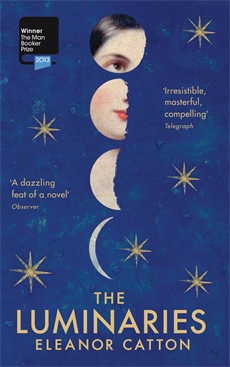
The Luminaries

“Never underestimate how extraordinarily difficult it is to understand a situation from another person’s point of view.”

A review by Miriam Huxley

Luminaries

I want to start out by saying that I really wanted to love this book.  But…I’ll preface that set of ellipses by saying that Catton’s novel is an achievement regardless of my overall conclusions.  Her dedication to her content and the quality of her research is immediately apparent.  There wasn’t a single moment when I felt anything was anachronistic to the time period or setting.  The integration of historical details was spot-on: never did it feel like information was being given simply for the sake of reminding the reader that this was a historical piece.

That being said, the novel was a tough read.  Granted, an 832-page novel is going to fluctuate in pace, but like the book itself, the prose started to feel both heavy and cumbersome.  By about page 700, the main mysteries had been solved and yet 132 pages remained.  I remember getting to that point and thinking “What next?”  Unfortunately, those 132 pages did a disservice to the (sometimes brilliant) prose in the first 700 pages.  I found myself reading right to the end simply because I wanted to say that I’d finished the book.  Within these pages, Catton goes into greater detail about the past experiences of the central characters, and though the content is interesting, it just didn’t contribute to the plot.  It was as if Catton felt the need to over-explain to a reader who couldn’t quite figure things out.  I’m not sure if the inclusion of these “summaries” was a decision made in an effort to follow the style Catton was attempting to replicate, or if Catton lacked confidence in her reader.  Either way, the over-explaining didn’t add anything critical.  The novel could have ended 700 pages in and I would have been satisfied.

Another major issue with The Luminaries is something I’d also like to briefly applaud.  Catton creates an absolutely massive cast of characters.  She includes a “Character Chart” at the very beginning of the novel which was helpful because it was often difficult to keep track of each character and what role they played.  Similarly, some of the male characters were indistinguishable in passages of dialogue.  That being said, Anna Wetherall, Emery Staines, Lydia Wells, Francis Carver, and Crosbie Wells were compelling characters.  Their stories formed the crux of the plot.  However, much of the novel was told from perspectives other than these aforementioned characters.  The novel begins with a long-winded section from Walter Moody—a compelling character himself who unfortunately doesn’t play much of a role later on in the book.  Other characters including Te Rau Tauwhare, Alistair Lauderback, Quee Long, and George Shephard have plotlines intertwined with the central characters, but their purpose gets slightly muddled as the novel progresses.  I think this novel would have been successful with a cast of characters half as long.

Other elements at work in The Luminaries are the zodiac signs and star charts throughout the novel.  Each character is assigned a sign and that sign is used to ascribe character traits.  The zodiac signs are also used to link characters and their plot lines.  But…it didn’t work for me.  I don’t have any particular knowledge of how zodiac signs or star charts work (and I don’t know that the average reader does either), but it didn’t add to the plot.  The star charts themselves were visually appealing, but I began to skip them as I progressed through the novel.

While The Luminaries begins as a murder mystery, it ultimately becomes a love story.  The last portion of the novel explains the love between Anna Wetherall and Emery Staines, both of whom are new in Hokitika and new to their respective trades (whoring and mining).  But I didn’t find their love story particularly compelling.  As the story unfolds, we learn that Anna has some kind of psychic connection to Staines (Lydia Wells says, “You may have an astral soul-mate, whose path through life perfectly mirrors your own” (716)), and is able to convincingly forge his signature despite the fact that she doesn’t know how to read or write.  I remain unconvinced.  The love story almost felt like an after thought, and, more importantly, it downplayed the importance of the murder mystery element (which was much more interesting).

Overall, I thought The Luminaries was commendable merely due to the amount of research that went into the development of the characters, the plot, and the setting.  I was completely immersed in 1865-6 New Zealand, fascinated as the frontier town grew throughout the course of the novel.  That being said, the prose became difficult to read, too much time was spent explaining things that didn’t need to be explained, and characters I connected to vanished before the conclusion of the novel.


Miriam Huxley

Miriam Huxley was born and raised in the wilds of British Columbia, but currently resides in Edinburgh, where she is completing a Master’s in Creative Writing.  She also has an expensive piece of paper that says she has a BA in English, History, and Honours in Creative Writing.  When she’s not writing witty prose, Miriam enjoys reading and critiquing books, experimental cooking, walking and running slowly, yoga, talking through movies, and listening to music of most genres (the good ones).

You can find Miriam at miriamhuxley.blogspot.co.uk and Instagram @miriamhuxley.


Be My Guest

Hello Readers!

A recent proposition has come to my attention, and since it has been something knocking around in my brain for a while, I’ve decided it’s a sign to take further action.

This is an open invitation to anyone interested in being a guest author for BookSick.

This can be a one-time post, or possibly more. You can be a current blogger, or someone who would just like to talk a bit about a particular book-related topic. At this early stage, I’d say I’m pretty flexible.


For any and all those interested, please contact me here or at booksickblog@gmail.com

I look forward to hearing from you! ❤

Go back

Your message has been sent

Warning
Warning
Warning
Warning

Warning.